 Book An Appointment

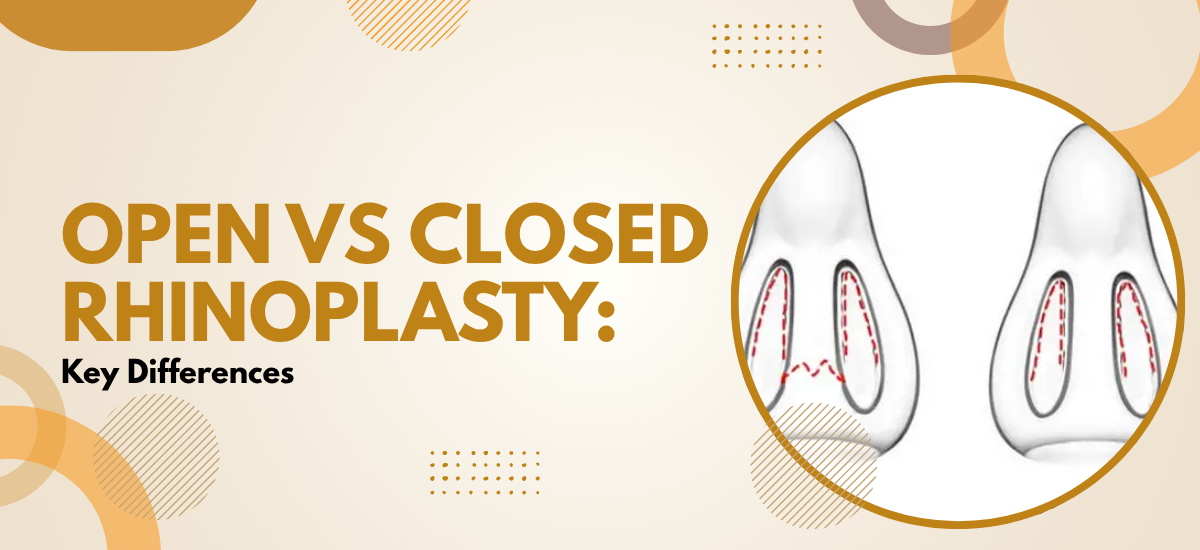
Open rhinoplasty uses a small external incision across the columella (the strip of skin between the nostrils) to lift the skin off the nasal framework, giving surgeons direct visual access to cartilage and bone for complex reshaping work, while closed rhinoplasty keeps all incisions hidden entirely inside the nose with no external scarring at all. The choice between techniques comes down to how much surgical access the case actually requires. Simple corrections work with closed technique. Complex reconstruction needs open technique. Surgeons fluent in both can match technique to anatomy rather than forcing every patient through whichever approach they’re comfortable with personally.
According to Dr. Monisha Kapoor, an experienced plastic surgeon in Delhi, “Open versus closed rhinoplasty isn’t a question of which is better, it’s a question of which approach the specific case actually needs, complex tip work or revision surgery often needs open access while simpler corrections can be done beautifully through closed technique with no external scar at all.”
Considering rhinoplasty and unsure whether your case needs open or closed technique? Book Appointment
How Does Each Rhinoplasty Technique Actually Work?
The two techniques approach the same nasal framework through completely different access routes. Open technique gives full visual access. Closed technique works through limited internal openings. Each has specific cases where it works best. Understanding the actual mechanics behind each helps patients see why their surgeon recommends one over the other for their specific anatomy and goals.
- Open Rhinoplasty Process: A small incision goes across the columella connecting the two nostril edges, the skin gets lifted up off the nasal cartilage and bone underneath, this gives the surgeon complete visual access to the entire nasal framework. Complex cartilage grafting becomes much easier with this access, the external incision heals into a thin barely visible line over time
- Closed Rhinoplasty Process: All incisions stay completely inside the nostrils with no external cuts at all, the surgeon works through these internal openings to access the underlying cartilage and bone structure. Visual access stays more limited compared to open technique, this works perfectly for straightforward cases but becomes restrictive for complex tip work or revision rhinoplasty
- Recovery Difference: Closed rhinoplasty typically has slightly less swelling around the nasal tip during early recovery because the columellar tissue stays undisturbed throughout surgery, the external healing phase is also faster since there’s no visible scar to manage. Open rhinoplasty involves slightly more tip swelling in the first few weeks but final results stay equivalent
- Scar Considerations: Closed rhinoplasty leaves zero external scarring at all, open rhinoplasty leaves a thin scar across the columella that fades to barely visible over 12 to 18 months. Patient skin tone and individual healing affect how quickly the open scar fades, darker skin tones sometimes need more time for the scar to settle into a less visible line
Both techniques deliver permanent nasal reshaping when performed properly, and patients exploring nose surgery options find that surgeon expertise and technique selection matter far more than which approach gets used as long as the surgeon is fluent in both techniques.
Open vs Closed Rhinoplasty: Which One Suits You?
Picking right comes down to how complex the case actually is, what kind of tip work the patient needs, whether revision surgery applies, and how comfortable the surgeon is with each technique. Patients exploring face and neck lift work alongside rhinoplasty also benefit from understanding which technique pairs better with combined facial procedures because access to the nasal tip affects how much detail work the surgeon can do during the same operation.
| Feature | Open Rhinoplasty | Closed Rhinoplasty |
| Incision Location | Across columella plus inside nostrils | Entirely inside nostrils only |
| Visual Access | Full direct access to nasal framework | Limited indirect access |
| Best Suited For | Complex tip work, revision surgery, cartilage grafting | Simple corrections, bridge work, straightforward cases |
| External Scar | Thin scar across columella, barely visible | No external scar at all |
| Tip Swelling Duration | Slightly longer in early recovery | Slightly less in early weeks |
| Surgical Time | 3 to 4 hours typically | 2 to 3 hours typically |
| Revision Capability | Strong access for revision corrections | Limited for complex revisions |
| Final Result Quality | Excellent for complex cases | Excellent for straightforward cases |
The right call depends on case complexity rather than personal preference for either approach, and a deeper read on rhinoplasty surgeon selection helps patients understand exactly what to ask surgeons about technique fluency before booking, because the surgeon’s range across both techniques shapes the actual outcome more than which approach gets chosen.
Why Choose Dr. Monisha Kapoor For Rhinoplasty Surgery?
Dr. Monisha Kapoor is the first Indian woman aesthetic plastic surgeon admitted to the American Society of Aesthetic Plastic Surgery and a member of ISAPS, with over 15 years of dedicated cosmetic surgery practice behind her. She handles rhinoplasty with fluency in both open and closed techniques, matches the technique to actual case complexity rather than personal preference, performs cartilage grafting where structure needs adding, and walks every patient through which approach genuinely suits their specific anatomy and goals during consultation.
📞 Call Now: +91 83739 84777
FAQs
Which rhinoplasty technique leaves visible scarring?
Open rhinoplasty leaves a thin barely visible columellar scar, closed leaves none.
Is open rhinoplasty better than closed?
Neither is universally better, technique choice depends entirely on case complexity needs.
Can closed rhinoplasty handle revision surgery?
Limited access makes closed rhinoplasty difficult for complex revision rhinoplasty cases.
Does open rhinoplasty have longer recovery?
Slightly more tip swelling early on, overall recovery stays similar between techniques.
References
- American Society of Plastic Surgeons — Rhinoplasty Techniques
- National Library of Medicine — Open vs Closed Rhinoplasty Outcomes
