 Book An Appointment

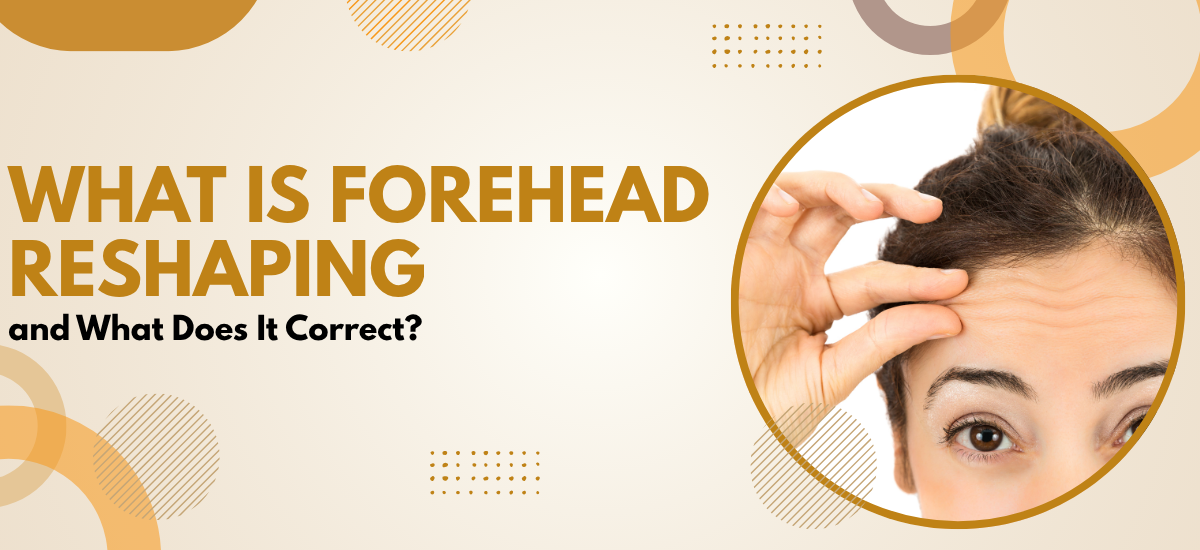
Forehead reshaping covers a group of surgical procedures that alter the height, contour, or bone structure of the forehead to improve facial proportion. Depending on what needs correcting, the approach involves moving the hairline forward to shorten a tall forehead, contouring a prominent brow ridge, or building out a flat upper face. Results are permanent and the change reads across the whole face rather than in isolation.
According to Dr. Monisha Kapoor, a trusted plastic surgeon in Delhi, “The forehead takes up the entire upper third of the face. When that proportion is off, every other feature gets affected visually. Correcting it structurally makes the whole face look more balanced, and that’s something no hairstyle or filler can fully replicate.”
Want to know whether forehead reshaping is the right procedure for your concern? Book a Consultation
What Can Forehead Reshaping Actually Correct?
The procedure addresses several distinct concerns, and the surgical technique used depends entirely on which problem is being fixed.
Tall or High Forehead A forehead that measures more than 6 to 7 centimeters from the brows to the hairline can make the face look top-heavy and disproportionate. Hairline lowering surgery advances the scalp forward and removes the excess forehead skin in between, shortening the visible height immediately. Results show from the day of surgery and stay permanently.
Prominent Brow Ridge A heavy brow bone that projects forward gives the face a masculine or stern appearance that has nothing to do with expression. The brow ridge is contoured down surgically through incisions placed within the hairline, leaving no external scars. Recovery involves some swelling across the first two to three weeks but the final shape is fully visible within a few months.
Flat or Receded Forehead Some patients have a forehead that slopes back or lacks natural projection in the upper face. Implants or bone cement are used to build forward projection and create a more balanced upper third. This is less commonly requested but makes a meaningful difference in profile view for patients where recession is the actual concern.
Asymmetry and Irregular Contour Irregularities in forehead shape from genetics, prior injury, or developmental variation can be smoothed and corrected surgically. This type of work is typically done with bone cement or small grafts applied precisely to the areas that need building up, rather than a broad structural change to the whole forehead.
The full surgical detail on techniques, candidacy, and recovery for hairline lowering is on the forehead treatment page.
Who Is a Good Candidate for Forehead Reshaping?
Patient selection is what separates good outcomes from disappointing ones, and not every forehead concern needs or suits surgery.
Forehead Height Over 6 to 7 cm Patients with a measured forehead height above this range who want a permanent fix rather than hairstyle management are well-suited candidates. The key factor is scalp laxity, since the scalp needs enough flexibility to be moved forward without tension.
Stable Hairline Hairline lowering works best when the existing hairline is relatively full and not actively thinning or receding. Patients with a receding hairline are often better served by a hair transplant first, or a combined approach where both techniques are used in stages.
Structural Brow Prominence Patients bothered by a brow ridge that projects forward need to confirm the concern comes from bone rather than soft tissue before planning surgery. If the issue is drooping brow tissue rather than bone projection, a brow lift is the more appropriate procedure.
Realistic Expectations and Good Health Candidates need to understand that surgery changes proportion, not the entire character of the face. Medical fitness, no history of keloid scarring, and willingness to follow post-operative care instructions are all part of proper candidacy.
Patients exploring how forehead reshaping relates to other upper face procedures can read through the brow lift blog, which explains how the two procedures differ and when they are combined.
Why Choose Dr. Monisha Kapoor for Forehead Reshaping?
Dr. Monisha Kapoor is India’s first woman aesthetic plastic surgeon admitted to the American Society of Aesthetic Plastic Surgery and holds active membership with ISAPS, with 25+ years of practice and over 10,000 procedures. Every forehead reshaping case at her Saket clinic is assessed individually for scalp laxity, hairline shape, and facial proportion before any surgical plan is made, which is what keeps results looking natural rather than operated.
📞 Call Now: +91 83739 84777
FAQs
How much can a forehead be reduced in one surgery?
Most patients achieve 1 to 3 centimetres of reduction in a single session depending on scalp laxity. Limited laxity cases may benefit from a combined hair transplant approach for additional improvement.
Will the scar from forehead reshaping be visible?
The incision sits along the natural hairline where surrounding hair conceals it. With proper healing the scar becomes very difficult to spot within 6 months.
Is forehead reshaping permanent?
Yes. The hairline or bone structure stays in its new position permanently. Natural ageing continues around the area but the surgical change does not reverse.
Can forehead reshaping be combined with other procedures?
Yes, it is commonly combined with a brow lift or rhinoplasty in a single surgical session for patients wanting more comprehensive facial proportion correction.
References
- National Library of Medicine — Hairline Lowering Surgery: Technique and Outcomes: https://pubmed.ncbi.nlm.nih.gov/28459473/
- National Library of Medicine — Forehead Contouring and Craniofacial Reshaping: https://pubmed.ncbi.nlm.nih.gov/30633880/
